

Across the equestrian world, there has long been a fascination with the mysterious connection between our equine companions and the celestial rhythms of the moon.
From ancient times to the present day, the idea that the moon’s cycles and vibrations may profoundly influence the behavior, health, and well-being of horses has captivated the imagination of horse enthusiasts and researchers alike.
This captivating article delves into the intriguing realm of Equine Lunar Resonance, exploring the evidence behind the potential impact of the moon’s phases on our beloved horses.
We’ll uncover the ancient ties between horses and the lunar cycles, examine the scientific data supporting the notion of equine biorhythms, and investigate how these celestial forces may shape various aspects of equine life, from breeding patterns to overall activity and mood.
Key Takeaways
- Horses have long been believed to have a deep connection with the moon’s cycles and vibrations.
- Scientific research suggests that equine biorhythms and behaviors may be influenced by lunar phases.
- The moon’s effects on mare reproductive cycles, stallion breeding patterns, and overall horse activity are explored.
- Equine Lunar Resonance may have significant implications for the care, management, and understanding of our equine companions.
- Observing horses during key lunar events, such as full moons and eclipses, can provide valuable insights into this intriguing phenomenon.
Introduction to Equine Lunar Resonance
Horses have long been revered for their deep connection to the natural world, and the lunar cycles have been a significant part of this relationship.
The ancient ties between equines and the moon can be traced back to the days when these majestic creatures were viewed as sacred messengers of the gods.
The Ancient Connection Between Horses and the Moon
In many cultures, horses were believed to possess a special sensitivity to the celestial influences that governed the rhythms of the natural world.
The waxing and waning of the moon was thought to have a profound effect on the behavior and well-being of these noble animals, with some civilizations even using equine biorhythms to predict and plan important events.
The Mystical Allure of Lunar Influences on Equines
The enduring fascination with the lunar influences on horses has captivated people throughout history. From ancient shamans to modern-day equestrians, the notion that the moon’s vibrations can impact the physiology and psychology of these majestic creatures has remained a source of intrigue and speculation.
As we delve deeper into the Equine Lunar Resonance, we uncover a world of mystical connections that continue to captivate and inspire those who share a profound bond with the horse.
The Science Behind Lunar Rhythms in Horses
While the connection between horses and the moon may have mystical roots, modern science has uncovered compelling evidence of the lunar influence on equine biology and behavior.
Researchers have delved into the ways in which the moon’s cycles can impact the internal rhythms and activities of horses, from hormonal fluctuations to behavioral patterns.
One fascinating area of study is the link between equine biorhythms and lunar rhythms. Studies have shown that horses exhibit distinct changes in their sleep-wake cycles, feeding habits, and overall activity levels in sync with the moon’s phases.
During full moons, for instance, horses tend to exhibit increased restlessness and altered sleep patterns, potentially due to the increased illumination and gravitational effects.
| Lunar Phase | Observed Equine Behavior |
|---|---|
| Full Moon | Increased activity, altered sleep patterns, heightened alertness |
| New Moon | Decreased activity, more settled sleep cycles, lower levels of agitation |
| Waxing Crescent | Gradual increase in activity and attentiveness |
| Waning Crescent | Gradual decrease in activity and attentiveness |
Another area of research focuses on the lunar effects on equine reproductive cycles. Studies have indicated that mares’ estrus cycles and fertility rates may be influenced by the moon’s phases, with some horses exhibiting more pronounced reproductive activity during specific lunar events.
This intriguing connection is an ongoing area of exploration for equine scientists and veterinarians.
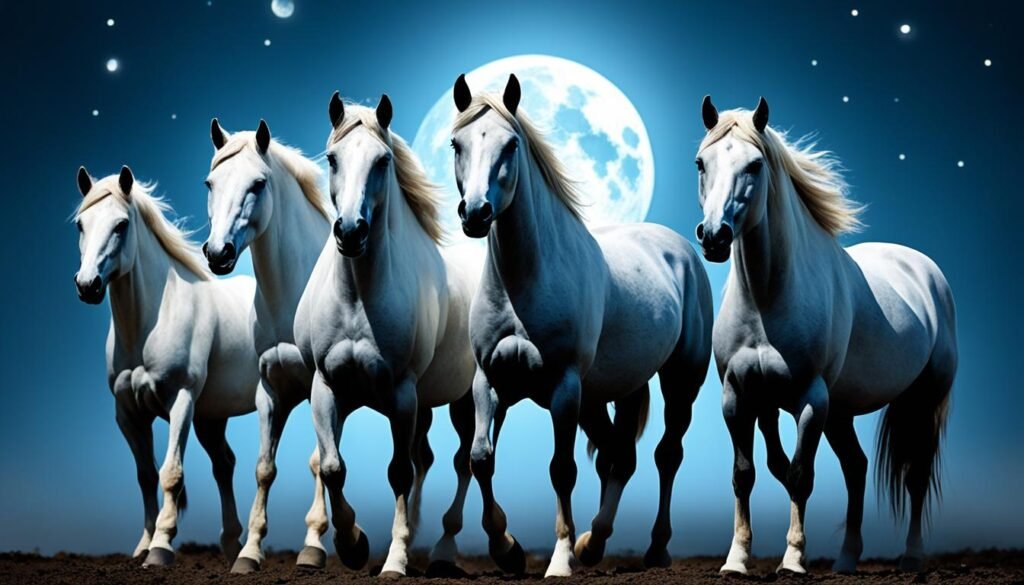
As our understanding of the science behind equine lunar rhythms continues to evolve, it’s clear that the moon’s influence on horses is a fascinating and multifaceted phenomenon.
By exploring these intricate connections, researchers hope to uncover new insights that can enhance our care and understanding of these magnificent creatures.
Mare Reproductive Cycles and the Moon
The intricate dance between mare reproductive cycles and the moon has long captivated equine enthusiasts. Extensive research has uncovered a remarkable connection between the lunar phases and the hormonal fluctuations that govern a mare’s estrus cycle, ovulation, and overall fertility.
Lunar Effects on Estrus and Fertility
Numerous studies have demonstrated that the moon’s gravitational pull can significantly influence a mare’s estrus cycle.
During the full moon, mares tend to exhibit heightened estrus behavior, with increased receptivity to breeding. Conversely, the new moon is often associated with a decrease in estrus activity and a reduction in fertility rates.
The lunar cycle’s impact on a mare’s reproductive system is thought to be mediated by the moon’s influence on the production and release of hormones, such as estrogen and progesterone.
These hormonal shifts can, in turn, affect the timing and duration of the mare’s estrus cycle, as well as the likelihood of successful ovulation and conception.
| Lunar Phase | Effect on Mare Reproductive Cycles |
|---|---|
| Full Moon | Increased estrus behavior and receptivity to breeding |
| New Moon | Decreased estrus activity and reduced fertility rates |
Understanding the lunar effects on mare reproductive cycles is crucial for horse breeders and owners who seek to optimize breeding schedules and increase the chances of successful conception.
By aligning breeding practices with the moon’s phases, equine professionals can harness the power of Equine Lunar Resonance to enhance their mare’s reproductive performance.
Stallion Breeding Patterns and Lunar Influences
While the moon’s cycles are known to impact the reproductive cycles of mares, they can also influence the breeding patterns of stallions. Equine researchers have uncovered fascinating insights into how the lunar phases may shape a stallion’s breeding behavior, libido, and overall reproductive success.
One well-documented phenomenon is the tendency for stallions to exhibit increased breeding activity during the full moon. This lunar-driven spike in libido is believed to be an evolutionary adaptation, as the bright light of the full moon may have once provided optimal conditions for successful breeding and foal survival in the wild.
Interestingly, the waxing and waning of the moon can also influence a stallion’s sperm quality and quantity. Studies suggest that sperm production and motility tend to be higher around the full moon, potentially enhancing a stallion’s fertility during this lunar phase.
For horse breeders, understanding these stallion breeding patterns and their lunar influences can be invaluable. By timing breeding activities to coincide with the optimal lunar conditions, they may be able to improve breeding success rates and the overall health of their foals.
However, it’s important to note that the lunar impact on stallion breeding is not a one-size-fits-all phenomenon. Individual horses may exhibit varying degrees of sensitivity to the moon’s influence, and other factors, such as genetics, environment, and management practices, can also play a role in a stallion’s reproductive behaviors.
Equine Lunar Resonance
The Potential Impact of Moon Vibrations on Horse Behavior
At the heart of Equine Lunar Resonance lies the idea that the moon’s vibrations and energy can profoundly influence the behavior of horses. Emerging research suggests that the lunar cycles may impact equine activity levels, mood, and even reproductive patterns.
One theory proposes that the moon’s gravitational pull and electromagnetic fields can affect a horse’s internal biological clock, known as its circadian rhythm. This, in turn, may lead to changes in energy levels, sleep patterns, and overall behavior during different phases of the lunar cycle.
Interestingly, some studies have found that horses may exhibit heightened restlessness, increased vocalization, and even elevated aggression around the time of a full moon. This phenomenon, known as “moon madness,” has been observed in various equine populations worldwide.
| Lunar Phase | Potential Behavioral Impacts on Horses |
|---|---|
| Full Moon | Increased activity, restlessness, and aggression |
| New Moon | Calmer demeanor, more focused behavior |
| Waxing Crescent | Gradual increase in energy and excitement |
| Waning Crescent | Decrease in activity and more relaxed state |
While the exact mechanisms behind the lunar effects on equine behavior are still being explored, the potential connection between Equine Lunar Resonance, lunar effects on equine behavior, and moon vibrations and horse behavior continues to captivate researchers and horse enthusiasts alike.
Celestial Influences on Equine Biorhythms
Horses have long been renowned for their close connection with the natural world, and the influence of the moon on their behavior and activity patterns is a captivating topic.
Beyond the well-documented effects on reproduction and behavior, the lunar cycles may also shape the overall biorhythms and daily routines of our equine companions.
Exploring the Link Between Lunar Phases and Horse Activity
Numerous studies have suggested that the moon’s phases can impact the circadian rhythms and activity levels of horses.
During the full moon, for example, some horses may exhibit increased wakefulness, restlessness, and even elevated levels of physical activity. Conversely, the new moon may be associated with a more subdued and relaxed demeanor in many equines.
- Anecdotal evidence and scientific research indicate that horses may be more alert and active during full moons
- The new moon phase, on the other hand, is often linked to a decrease in equine activity and a more tranquil state
- These lunar influences on equine biorhythms may be tied to the moon’s effect on natural light levels and the horses’ evolutionary adaptations
While the exact mechanisms behind these lunar-equine connections are not yet fully understood, the observations and data suggest that the celestial bodies may indeed play a significant role in shaping the daily lives and routines of our four-legged friends.
Continued research in this fascinating field may shed further light on the intricate relationship between equine biorhythms, lunar rhythms in horses, and lunar phases and horse activity.
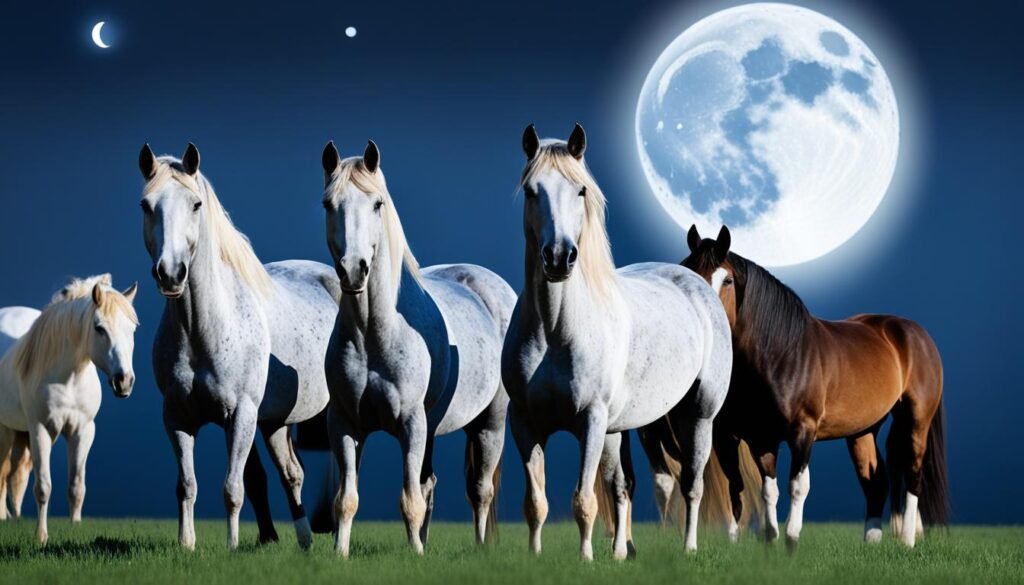
Moon Phases and Their Impact on Equines
The moon’s phases can have a profound impact on the behavior and well-being of horses. From the mysterious pull of the new moon to the energetic surge of the full moon, each lunar cycle can influence various aspects of equine life. Understanding these lunar rhythms can provide valuable insights for horse owners and caretakers.
During the new moon phase, when the moon is not visible in the sky, horses may exhibit increased restlessness and nervousness.
This can be attributed to the moon’s gravitational effects on the earth, which can subtly influence the horse’s internal rhythms and hormonal balances.
As the moon waxes toward its full phase, horses often become more active and spirited. The full moon is particularly known for its potential to amplify equine behavior, with some horses becoming more excitable, easily startled, or even aggressive.
This lunar effect is thought to be linked to the moon’s ability to affect the horse’s natural sleep-wake cycles and hormone production.
| Lunar Phase | Potential Equine Impact |
|---|---|
| New Moon | Increased restlessness and nervousness |
| Waxing Moon | Heightened activity and energy |
| Full Moon | Excitability, startle response, and aggression |
| Waning Moon | Calmer and more docile behavior |
As the moon wanes, horses often exhibit a more calming and docile demeanor. This phase is thought to have a soothing effect on equine behavior, allowing for a more balanced and tranquil atmosphere in the stable or pasture.
By understanding the potential influence of moon phases on horses, owners and caretakers can better manage their equine companions, adjusting training routines, handling techniques, and even schedules to accommodate the natural rhythms of the lunar cycle.
This knowledge can contribute to a more harmonious and enriching relationship between humans and their equine partners.
Equine Behavior During Lunar Events
Equine enthusiasts have long observed intriguing changes in horse behavior during certain lunar events, such as full moons and eclipses.
These celestial occurrences have been associated with a range of equine responses, from increased restlessness and heightened senses to more erratic movements and heightened aggression.
Observing Horses During Full Moons
During full moons, horses have been reported to exhibit a heightened sense of awareness, often becoming more alert and responsive to their surroundings. Some horse owners have noted their animals displaying increased activity levels, with some horses seemingly more energetic and difficult to handle.
Anecdotal evidence also suggests that horses may be more prone to startling or reacting more strongly to unexpected stimuli during these lunar phases.
Interestingly, the lunar effects on equine behavior during full moons have also been linked to changes in sleep patterns and circadian rhythms. Some studies have hinted at the possibility of lunar-induced alterations in hormone levels, which could contribute to the observed behavioral shifts in horses.
FAQ
What is the connection between horses and the moon?
Horses have long been revered for their deep connection to the natural world, and the moon has been a significant part of this relationship.
The ancient ties between horses and the lunar cycles can be traced back to the days when equines were viewed as sacred messengers of the gods. The mystical allure of lunar influences on equines has captivated people throughout history.
Is there scientific evidence of lunar rhythms in horses?
Yes, modern science has uncovered compelling evidence of the lunar influence on equine biology and behavior. Researchers have found that the moon’s cycles can impact the internal rhythms and activities of horses, from hormonal fluctuations to behavioral patterns.
How do the moon’s phases affect mare reproductive cycles?
One of the most well-documented aspects of Equine Lunar Resonance is the impact of the moon on mare reproductive cycles.
The lunar phases can influence a mare’s estrus cycle, ovulation, and overall fertility, highlighting the intricate relationship between the moon and equine reproduction.
Do stallion breeding patterns also show lunar influences?
Yes, the moon’s cycles can also influence the breeding patterns of stallions. Researchers have found that the lunar phases may impact a stallion’s breeding behavior, libido, and overall reproductive success, providing valuable insights for horse breeders and owners.
Can the moon’s vibrations affect horse behavior?
At the heart of Equine Lunar Resonance lies the idea that the moon’s vibrations and energy can influence the behavior of horses. Experts suggest that the lunar cycles may impact equine behavior, from changes in activity levels to alterations in mood and temperament.
How do lunar phases influence equine biorhythms?
Beyond the direct effects on reproduction and behavior, the moon’s cycles may also influence the overall biorhythms and activity patterns of horses. Researchers have found a relationship between lunar phases and equine circadian rhythms, suggesting that the celestial bodies may shape the daily lives and routines of our equine companions.
How do different moon phases impact horses?
Each phase of the moon, from the new moon to the full moon, may have distinct impacts on horses. Experts have observed that the different lunar phases can influence various aspects of equine well-being, including behavior, physiology, and overall health.
Do horses exhibit unique behaviors during lunar events?
Certain lunar events, such as full moons and eclipses, have long been associated with changes in equine behavior. Observations and anecdotal evidence suggest that horses may respond to these celestial occurrences in unique ways, providing insights for both horse owners and enthusiasts.